
Kubota B2601HSD vs Kioti CS2510 vs John Deere 1025R vs TYM T254: The Honest Sub-Compact Comparison
Kubota B2601HSD vs Kioti CS2510 vs John Deere 1025R vs TYM T254
Four 25-horse sub-compacts, sorted out by loader muscle, hydraulics, hitch, and what owners actually live with.
Bottom line: if you're cross-shopping these four, the Kubota B2601HSD is the loader and hitch heavyweight of the group and the safest first-tractor pick, the John Deere 1025R wins on ease of use and dealer/parts depth, the Kioti CS2510 gives you the most tractor for the dollar, and the TYM T254 is the value play with a strong Yanmar engine if you have a committed dealer nearby. Pick the Kubota or Deere if dealer support and resale matter most; pick the Kioti or TYM if your budget is tight and you've checked out the local dealer in person.
These four land in the same showroom bracket for a reason: all are 24-to-25 horsepower diesels, all hydrostatic, all 4WD, all sized to mow a few acres, move gravel, and run a backhoe on weekends. People cross-shop them because the spec sheets look nearly identical. The mistake first-time buyers make is treating engine horsepower as the deciding number. It isn't. At this size every engine is plenty. What actually separates these machines is loader lift, hydraulic flow, three-point hitch capacity, and the dealer who picks up the phone when something breaks. That's where the gaps show up, and that's what this comparison digs into.
The numbers that actually decide it
| Spec | Kubota B2601HSD | Kioti CS2510 | John Deere 1025R | TYM T254 |
|---|---|---|---|---|
| PTO Power | 19.5 hp | 19.4 hp | 18.2 hp | 18.8 hp |
| Gross Engine Power | 24.3 hp | 24.5 hp | 23.9 hp | 23.9 hp |
| Engine Maker | Kubota | Shibaura | Yanmar | Yanmar |
| Loader Lift @ Full Height | 948 lb | 683 lb | 754 lb | 948 lb |
| Loader Breakout Force | 2,146 lb | 1,435 lb | 1,823 lb | 1,680 lb |
| Loader Lift Height | 78.5 in | 70.9 in | 72 in | 75 in |
| 3-Point Lift (at 24") | 1,290 lb | 700 lb | 758 lb | 1,101 lb |
| Total Hydraulic Flow | 8.3 gpm | 6.5 gpm | 6.3 gpm | 6.9 gpm |
| Transmission | HST, 3 ranges | HST, 2 ranges | HST, 2 ranges | HST, 2 ranges |
| Max Forward Speed | 12.7 mph | 10.3 mph | 9.1 mph | 11.0 mph |
| Tractor Weight | 1,632 lb (w/loader) | - | 1,556 lb (base) | - |
| Powertrain Warranty | 72 mo / 2,000 hr | 48 mo (driveline) | 72 mo / 2,000 hr | Up to 3,000 hr |
The four contenders
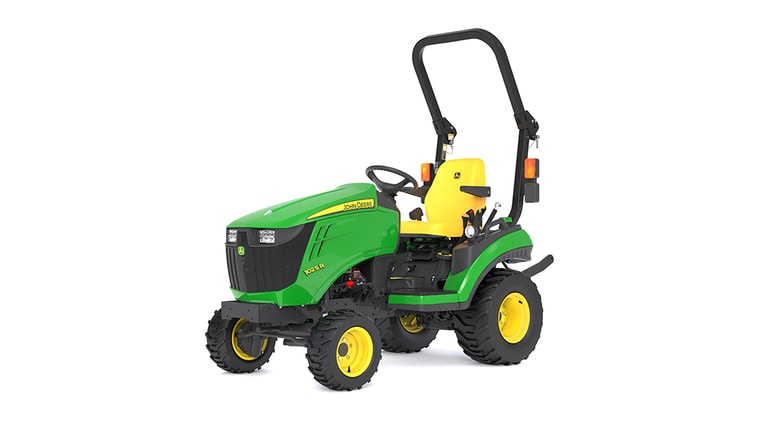
Loader Performance: Lift, Breakout, and Reach
This is the category most owners care about, because moving material is what a sub-compact does most days. The Kubota B2601 leads outright. Its LA435 lifts 948 pounds at full height and breaks out at 2,146 pounds, which is a meaningful margin over the rest. The TYM T254 matches the Kubota's 948-pound lift on paper, and one long-term owner who weighed it with a crane scale reported the front loader pulled more than the rated number in practice.
The John Deere 1025R sits in the middle at 754 pounds with the 120R loader, and the Kioti CS2510 brings up the rear at 683 pounds. That gap is real and you'll feel it loading wet gravel or a full bucket of soil. Where the Kubota also wins is dump height: 78.5 inches lets you clear the side of a trailer that the Kioti's 70.9 inches won't. None of this means the Deere or Kioti can't do loader work. It means if heavy loader work is your priority, the orange tractor and the TYM are the ones built for it.
We are very happy with the T254 and it has completed every task we asked of it. The T254 will lift 1200lbs on the front loader and we tested that with a crane scale.
Three-Point Hitch and PTO for Rear Implements
If you're running a rotary cutter, box blade, tiller, or rear blade, the three-point lift number tells you how heavy an implement you can pick up. Here the spread is dramatic. The Kubota B2601 lifts 1,290 pounds at 24 inches behind the hitch. The TYM T254 is close behind at 1,101 pounds. The John Deere 1025R and Kioti CS2510 are roughly half that, at 758 and 700 pounds respectively.
That difference matters more than the loader gap for anyone planning serious ground-engaging work. A heavier box blade or a 60-inch cutter pushes the Deere and Kioti to their limits, while the Kubota and TYM have headroom. All four run an independent 540-rpm rear PTO and offer a mid-PTO for a belly mower, so for mowing duty they're even. The decision tilts on what you hang off the back.
Hydraulic Flow for Loaders and Attachments
Hydraulic flow drives how fast your loader cycles and whether you've got the capacity to run a third-function attachment like a grapple. The Kubota's 8.3 gpm dual-pump system is the strongest of the four and noticeably quicker on loader cycles. The TYM T254 follows at 6.9 gpm, then the Kioti at 6.5 and the Deere at 6.3.
Worth knowing: the Deere splits its flow into a dedicated 3.5-gpm steering circuit and a 3.5-gpm implement circuit, and offers up to three optional rear remote valves, which is generous for the class and handy if you run multiple hydraulic implements. The Kubota and TYM each offer a single optional rear remote. One detail buyers should hear straight: some B2601 owners have reported hydraulic pressure dropping over time and affecting lift, with a shim adjustment being the typical fix, so it's worth a careful look at a used machine.
Transmission, Travel Speed, and Day-to-Day Feel
All four are hydrostatic, so there's no clutching, just press a pedal and go. The Kubota is the only one with a three-range HST; the other three are two-range. That third range gives the Kubota the highest top speed at 12.7 mph and better speed control across jobs, which matters if you're covering ground between a barn and a back field.
The TYM is next at 11.0 mph, the Kioti at 10.3, and the Deere is the slowest at 9.1 mph. Where the Deere claws it back is ergonomics. Owners repeatedly call out its twin-touch foot pedals, tilt wheel, and loader joystick placement as the most intuitive setup in the group, especially for new operators. By contrast, some B2601 owners find the rocker-style HST pedal stiff and report a sore knee after long sessions, with seat adjustment helping. None of these are dealbreakers, but they're the kind of thing you only learn by sitting in the seat, so test-drive before you sign.
After buying my JD 1025R I can assure you the quick detach loader and drive over deck are worth their weight in gold. I can take the loader off in 30 seconds or less.
Serviceability and Ground Clearance
Ground clearance separates the work-in-rough-terrain machines from the lawn-focused ones. The Kubota B2601 has the most at 12.8 inches, which is why it's a common woods and pasture pick. The TYM T254 has 9.4 inches, the Deere 7.7, and the Kioti just 6.4. That low Kioti number is something to weigh if you'll cross ruts, rocks, or stumps; on a flat property it won't matter.
Serviceability favors the established brands. Owners praise Deere's flip-forward seat and easy access, and both Kubota and Deere have deep parts pipelines. On the value side, one long-time Kioti owner of a different model summed up the brand's reliability bluntly, and TYM owners generally report stout builds, though TYM's dealer network is thinner and several owners note dealers dropping the line. That's the trade with the value brands: the machine can be excellent, but support depends heavily on your specific local dealer.
I've owned a Kioti DK 35 for 14 years now (nearing 2000 hours). Nice machine, never gives me any problems. Parts are not a problem.
Dealer Network, Warranty, and Resale
Warranty coverage is a real differentiator here. Kubota and John Deere both back the powertrain for 72 months or 2,000 hours, which is strong. TYM advertises bumper-to-bumper coverage and powertrain protection out to 3,000 hours, the longest hour limit of the group, while Kioti's driveline coverage runs 48 months. On paper, TYM and the two majors lead.
But warranty is only as good as the dealer who honors it. This is where the conversation on the forums keeps landing: buyers repeatedly say the deciding factor came down to the strength of the local dealer, not the badge. Kubota and Deere have the densest networks and the best resale, which protects you if you sell in a few years. Kioti and TYM typically save you real money up front, and current dealer pricing on a Kioti CS2510 with loader has run around $20,000 to $22,000 as of 2025, with TYM T254 tractor-and-loader packages advertised lower. Just confirm the dealer is solid and not on the way out before you buy.
The hydraulic whine noise was much louder on the Kubota. The Deere had substantially more fel lift capacity. The Deere turned sharper.
Who should pick which:
Pick the Kubota B2601HSD if loader and hitch capacity top your list, you want the most ground clearance for rough terrain, and you value a dense dealer network and strong resale. It's the most capable all-rounder here and the safest first tractor.
Pick the John Deere 1025R if ease of operation and parts availability matter most, especially as a first-timer. It's the friendliest to learn on with the best ergonomics and quick-attach loader and deck, but it lifts the least up front and trails on travel speed.
Pick the Kioti CS2510 if you want the most tractor for the dollar on a flat property under five acres, and you've got a good local Kioti dealer. Know going in that its loader lift, hitch capacity, and ground clearance are the lowest of the four.
Pick the TYM T254 if you want strong loader and hitch numbers and a proven Yanmar engine at a value price, and there's a committed TYM dealer near you. It punches above its price, but dealer coverage is the variable to confirm first.
Common Questions From Buyers Cross-Shopping These Four
Is the Kubota B2601 better than the John Deere 1025R for loader work on a hobby farm?
Yes, on the numbers. The B2601's LA435 loader lifts 948 pounds at full height with 2,146 pounds of breakout, versus 754 pounds and 1,823 pounds for the Deere 120R, and the Kubota dumps higher too. The Deere counters with easier controls and quicker attachment swaps, so if you're a first-timer doing light loader work, the Deere is friendlier; for heavy material handling, take the Kubota.
Why is the Kioti CS2510 cheaper than the Kubota and John Deere if it's the same horsepower?
You're paying for dealer network, resale value, and brand depth, not engine power. The Kioti actually has the highest gross horsepower of the group at 24.5, but it gives up loader lift, three-point capacity, ground clearance, and hydraulic flow to the Kubota. Owners consistently report Kioti machines are reliable and parts aren't a problem, so the savings are real if your local dealer is solid.
Does the TYM T254 really lift as much as the Kubota B2601 on the front loader?
On paper they're tied at 948 pounds of loader lift at full height. One TYM owner who measured his with a crane scale reported it pulled even more than rated. The T254's three-point lift of 1,101 pounds also trails only the Kubota, so for both loader and rear-implement work the TYM is genuinely competitive with the orange tractor at a lower price.
Which of these sub-compact tractors is best for a property with hills, ruts, and rough ground?
The Kubota B2601 leads with 12.8 inches of ground clearance, followed by the TYM T254 at 9.4 inches. The John Deere 1025R has 7.7 inches and the Kioti CS2510 just 6.4, which can be a problem crossing rocks or stumps. Add rear ballast on any of them for hillside stability, and test-drive on terrain like yours before deciding.
How much does a Kioti CS2510 with a loader cost compared to a Kubota B2601 in 2025?
A Kioti CS2510 with loader has been running around $20,000 to $22,000 as of 2025 depending on tires and dealer incentives, while Kubota B2601 tractor-and-loader packages have commonly landed in the low-to-mid $20,000s. Pricing swings hard with rebates, region, and inventory, so get written quotes from multiple dealers rather than trusting a single sticker.
Should I buy a Kioti or TYM to save money, or stick with Kubota or John Deere?
If a strong local dealer carries the Kioti or TYM, the savings are real and the machines are capable. The risk with the value brands is thinner dealer coverage, and some owners have watched their local TYM dealer drop the line. With Kubota and Deere you pay more but get the densest service networks and the best resale, which is worth it if you plan to sell in a few years.