
Kubota B2601HSD vs Yanmar SA325 vs John Deere 1025R vs TYM 2610: Which Sub-Compact Should You Buy?
Kubota B2601HSD vs Yanmar SA325 vs John Deere 1025R vs TYM 2610
Four 24-hp sub-compacts, four very different ways to spend $20K. Here's how they actually stack up.
Bottom line: If you're cross-shopping these four, the Kubota B2601 and Yanmar SA325 are the all-arounders, with the Yanmar undercutting Kubota on price and warranty while the Kubota wins on dealer density and 3-range transmission. The John Deere 1025R is the lightest and the priciest, and you buy it for the dealer network and resale, not the raw lift numbers. The TYM 2610 is the value play and the heaviest of the bunch with the tallest loader, but you take on a thinner dealer footprint to get there.
These four land in the same showroom corner for a reason: roughly 24 gross horsepower, a hydrostatic transmission, a Category 1 (or limited Cat 1) hitch, and a quick-attach loader. That's where the similarity ends.
The mistake first-time buyers make is shopping engine horsepower. In this class the engines are within a couple horses of each other and two of these tractors literally share the same Yanmar-built engine. What actually separates them is weight, loader geometry, hydraulic flow, the transmission layout, and the dealer who picks up the phone when something breaks. A heavier tractor with a taller loader and a worse dealer can be the wrong buy even when the spec sheet looks great. Spend your attention there.
The numbers that actually drive the decision
| Spec | Kubota B2601HSD | Yanmar SA325 | John Deere 1025R | TYM 2610 |
|---|---|---|---|---|
| PTO horsepower | 19.5 hp | 18.1 hp | 18.2 hp | 18 hp |
| Gross engine hp | 24.3 hp | 23.9 hp | 23.9 hp | 24 hp |
| Engine maker | Kubota | Yanmar | Yanmar | TYM |
| Tractor weight | 1,632 lb (w/ loader) | 1,715 lb (w/ loader) | 1,556 lb (base) | ~2,110 lb (base) |
| Loader lift cap. (full height) | 948 lb | 1,200 lb | 754 lb | 1,373 lb |
| Loader breakout force | 2,146 lb | 2,090 lb | 1,823 lb | 2,077 lb |
| Loader lift height | 78.5 in | 79 in | 72 in | 91.1 in |
| 3-pt lift at 24 in | 1,290 lb | 1,209 lb | 758 lb | 974 lb |
| Total hydraulic flow | 8.3 gpm | 8.0 gpm | 6.3 gpm | 7.4 gpm |
| Standard rear remotes | - | 2 | - | 0 |
| Transmission | HST, 3 ranges | HST, 2 ranges | HST, 2 ranges | HST, 3 ranges |
| Top speed (fwd) | 12.7 mph | 12.3 mph | 9.1 mph | 17 mph |
| Powertrain warranty | 72 mo / 2,000 hr | 10 yr / 3,000 hr | 6 yr / 2,000 hr | 3,000 hr drivetrain |
The four contenders
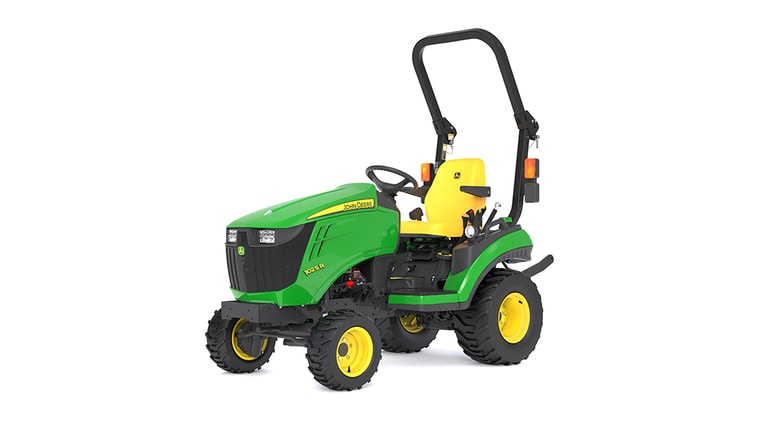
Loader Performance and Lift Capacity
Loader work is what 90 percent of these tractors do, so start here. On paper the TYM 2610 wins outright: 1,373 lb of lift at full height and a 91.1-inch lift height that clears the side of a dump trailer the others can't. The Yanmar SA325 is next at 1,200 lb to the pivot pin. The Kubota B2601 lifts 948 lb and the John Deere 1025R brings up the rear at 754 lb. Breakout force, the muscle for prying material loose at the bucket, runs the opposite direction and tightens up: Kubota leads at 2,146 lb with the SA325 and TYM within about 70 pounds of it, and the Deere lowest at 1,823 lb.
Two cautions before you fall in love with a lift number. First, weight matters as much as the loader rating. The TYM is the heavy one here at roughly 2,110 lb base, which is why it digs better than its lighter rivals. Owners who've handled this class echo it.
Second, those ratings assume a bare bucket. Hang a grapple on the front and your usable capacity drops fast. And whatever you buy, you need rear ballast to lift safely. That's not optional advice; it's the difference between lifting your rated load and standing the back tires up off the ground.
Its weighs about 800lbs more than the T254 and digs dirt a lot better.
Add a 600 pound grapple and you will reduce the lift capacity by about 800 pounds... a realistic lift capacity will be in the 800-1000 pound range. Be sure to add lots of rear ballast.
Transmission, Travel Speed, and Day-to-Day Driving
All four run a hydrostatic transmission, so there's no clutch to feather and your foot controls speed directly. The differences are in the ranges and the pedal layout.
The Kubota and TYM both give you three ranges instead of two. That ultra-low gear is genuinely useful for slow, precise loader and tiller work, and Deere owners notice when they don't have it. The TYM is also the speed demon of the group at a claimed 17 mph forward, which makes it the one to look at if you're covering distance between chores. Kubota tops out at 12.7 mph, Yanmar at 12.3, and the 1025R is the slowpoke at 9.1 mph.
Pedals are where this gets personal, and you can't settle it from a spec sheet. Kubota uses a single rocker-style treadle pedal; the Yanmar and Deere use two side-by-side pedals. Some owners find the Kubota treadle intuitive and praise its HST pedal arrangement. Others can't stand it. The only way to know which camp you're in is to drive both before you sign.
I like the 3 point control, hst pedal, tilt steering, and the lower rpm working range compared to the BX.
Hydraulic Flow and Remote Valves for Implements
Hydraulic flow decides how fast your loader cycles and whether you can run hungry attachments like a grapple, an angle blade, or a hydraulic top link. Kubota leads at 8.3 gpm total, Yanmar at 8.0, TYM at 7.4, and the John Deere 1025R is noticeably lower at 6.3 gpm. In practice the Deere's loader cycles a little slower, which you feel over a long day of repetitive lifts.
The sleeper advantage here is the Yanmar. It ships with two standard rear remote valves. The Kubota offers a single rear remote as an option, and the TYM comes with zero standard remotes and offers two as an option. If you already know you want a hydraulic-controlled rear blade or a log splitter, the SA325 saves you a dealer add-on out of the gate. Don't overlook that line item.
Comfort, Ergonomics, and Serviceability
Comfort is subjective, but a few patterns show up consistently. The Yanmar and Deere seats come with adjustable armrests; the Kubota's does not, and the Kubota is also the only one of the trio without a mounting step, which gets old when you're climbing on tired or in the mud. The Deere's fit and finish gets praised loudly by its own owners, even ones who concede the Kubota is just as capable a machine.
The Yanmar earns points for its operator station too, with a spring-suspension seat platform and fore-and-aft adjustment, and a tight 8.5-foot turn radius. One thing to flag honestly: a few SA325 owners have reported the plastic hood panels cracking early. In the cases owners describe, the dealer handled it under warranty, but it's worth a look during your walkaround.
The TYM gets credit for a comfortable suspension seat and strong maneuverability, though it's the longest tractor here at nearly 123 inches with the hitch, so it's less nimble in truly tight quarters than its turn-radius spec suggests.
Overall ergonomics there is no comparison. The deere outshined it in every possible way. The one thing I did like about the Kubota was the 3spd tranny.
Warranty, Dealer Network, and Long-Term Support
This is the category that quietly decides whether you're happy in year four, and it's where the spec sheet lies to you.
On paper Yanmar has the strongest warranty: 10 years or 3,000 hours on the powertrain, standard. Kubota gives 72 months/2,000 hours powertrain on residential use, Deere 6 years/2,000 hours, and TYM covers drivetrains up to 3,000 hours. The Yanmar number is a real selling point, and shoppers cite it as a reason to pick it over the Kubota.
But warranty is only as good as the dealer who honors it. Kubota and John Deere have the densest networks, and Deere owners in particular tell stories of dealers going out of their way. The hard truth for TYM and Yanmar shoppers is that dealer coverage is thinner and turns over more. Forum owners repeatedly warn that a selling dealer promising 'any local shop can do your warranty work' is a red flag, because the first question a service department asks is whether you bought the machine there. Before you choose on price or warranty length, find out exactly where your nearest dealer is and how long they've carried the brand. That single fact should weigh as heavily as any number in the spec table.
Go with the one that you can get dealer warranty service. Third party warranty service does not work out well.
Who should pick which:
Pick the Kubota B2601HSD if you want the best blend of dealer network, hydraulic flow, and a 3-range transmission, and you don't mind the treadle pedal once you've test-driven it. It's the safe, capable default and resale is excellent.
Pick the Yanmar SA325 if value and warranty drive your decision. You get the most loader lift and 3-point lift of the three name brands, two standard rear remotes, and a 10-year powertrain warranty, often a couple thousand dollars under the Kubota, provided you have a solid Yanmar dealer nearby.
Pick the John Deere 1025R if dealer support, fit-and-finish, and resale matter more to you than raw lift numbers. It's the lightest and least powerful on hydraulics and loader capacity here, but the ownership experience and dealer network are why people pay the premium.
Pick the TYM 2610 if you want the most tractor for the money: the heaviest machine, the tallest and highest-lifting loader, three ranges, and real transport speed. The trade is a thinner, less predictable dealer footprint, so only buy it if you've got a strong local TYM dealer you trust.
Common questions buyers ask about these four tractors
Is the Yanmar SA325 better than the Kubota B2601 for loader work on a hobby farm?
For raw lift, yes: the SA325 lifts about 1,200 lb at full height versus the Kubota's 948 lb, and it includes two standard rear remotes. The Kubota counters with slightly higher breakout force, a 3-range transmission, and a denser dealer network. If lift capacity and price drive your decision and you have a good Yanmar dealer, the SA325 is the stronger loader value.
Why is the John Deere 1025R more expensive when it lifts less than the others?
You're paying for the dealer network, the fit and finish, and the resale value, not the spec sheet. The 1025R is the lightest tractor here with the lowest hydraulic flow and loader capacity of the group. Owners who buy it consistently say the ownership experience and dealer support are worth the premium, but if you're chasing lift numbers per dollar, it's not the value pick.
Is the TYM 2610 reliable, and should I worry about getting it serviced?
The tractor itself is well-built and heavy for its class, and owners report it digs better than lighter rivals thanks to the extra weight. The real risk is the dealer network, which is thinner and turns over more than Kubota's or Deere's. Buy it only if you have a strong, established TYM dealer near you, because forum owners warn that third-party warranty service rarely works out.
Which of these sub-compact tractors has the best warranty?
On paper, Yanmar wins with a standard 10-year or 3,000-hour powertrain warranty. Kubota offers 72 months/2,000 hours on residential use, Deere 6 years/2,000 hours, and TYM covers drivetrains up to 3,000 hours. Just remember a warranty is only worth as much as the dealer who honors it, so factor in dealer proximity before you choose on warranty length alone.
Do I really need rear ballast to use the loader on a 24-hp tractor?
Yes, on every one of these. Loader lift ratings assume the tractor stays planted, and lifting near capacity without rear ballast can pick the back tires off the ground. A ballast box or loaded rear tires is essential, and owners consistently say it's the first thing to add. It also improves traction and ride.
Kubota B2601 vs John Deere 1025R: which should a first-time buyer get?
Both are excellent first tractors, so this often comes down to which dealer treats you better and which pedal layout you prefer. The Kubota gives you more hydraulic flow, a 3-range transmission, and more loader capacity for similar or less money. The Deere counters with lighter weight, top-tier fit and finish, and one of the strongest dealer networks. Test drive both, because the Kubota's treadle pedal is love-it-or-hate-it.